
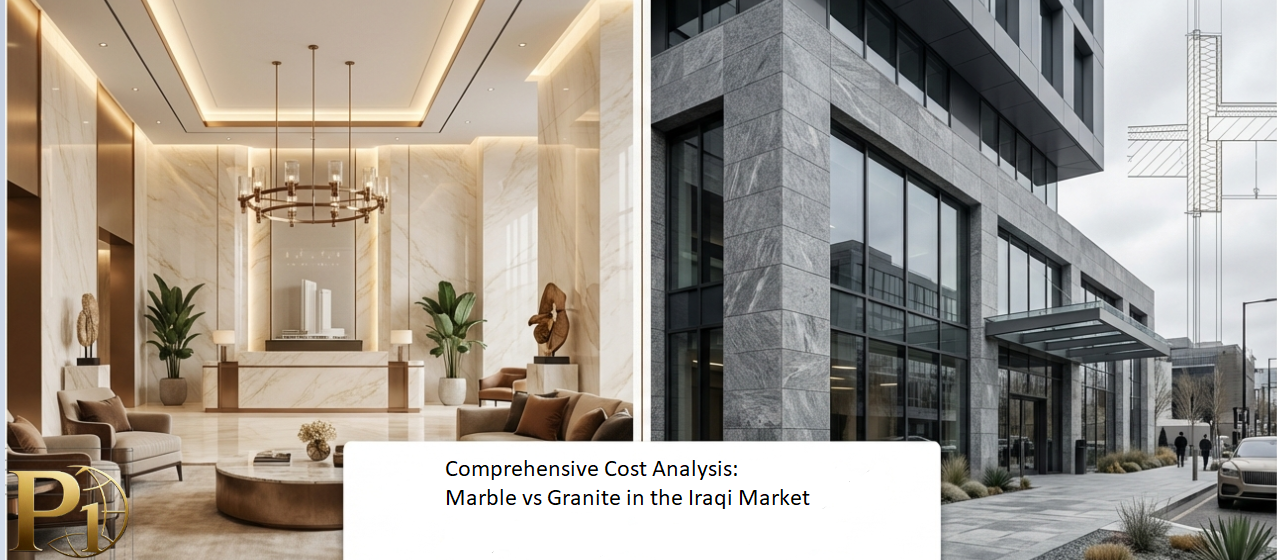
Comprehensive Cost Analysis: Marble vs Granite in the Iraq Construction Market
In Iraqi construction projects, choosing between marble and granite is a key decision that goes beyond aesthetics, directly impacting the project’s budget and profitability. Many contractors and builders face the question: is the higher cost of certain types of marble worth the investment, or is the durability and more competitive price of granite a more economical choice? This article provides an in-depth analysis of Iraq marble prices compared to Iraq granite prices, helping you make the smartest financial decision for your project by fully understanding the cost of construction stones in Iraq.
Beyond the Price per Meter: Why Stone Budget Analysis is Vital?
Making a decision solely based on the initial price per square meter of stone is a strategic mistake. A comprehensive budget analysis considers both visible and hidden costs throughout the stone’s life cycle, leading to a clear understanding of the true cost of each choice.
Impact of Initial Cost on Total Project Budget
The cost of purchasing stone constitutes a significant portion of a project’s material budget. The price difference between standard granite and luxury marble can amount to tens of thousands of dollars in a medium-sized project. This initial choice can directly affect budget allocation for other sectors, such as installation, final processing, and even interior decoration.
Long-Term Value: Which Stone is the Smarter Investment?
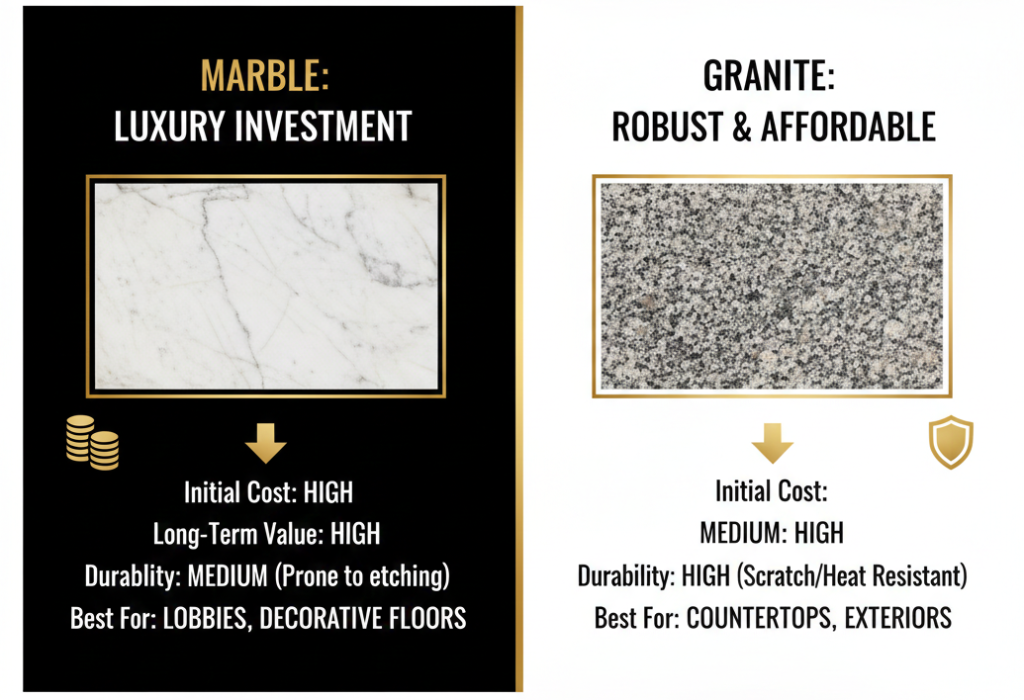
A smart investment looks toward the future. Due to its extraordinary durability and low maintenance requirements, granite minimizes repair and renovation costs in the long run. On the other hand, marble, by creating a luxurious and unique atmosphere, can significantly increase the resale value of the property. Therefore, the key question is: Is your goal to reduce current costs or to increase the final investment value?
Maintenance Cost: A Decisive Factor in the Final Choice
Marble, especially in spaces like kitchens or entrances, requires periodic care and the use of protective sealers due to its sensitivity to acidic substances and potential for staining. These maintenance costs must be included in long-term calculations. In contrast, granite, due to its high resistance, imposes almost no additional maintenance costs, which is considered a major economic advantage.
Anatomy of Factors Affecting Stone Prices
The price you see on a stone slab is the final result of a long journey from the heart of a mountain to a dealer’s warehouse in Baghdad. Understanding the factors that influence Iraq marble prices and Iraq granite prices along this path gives you bargaining power and the ability to choose more wisely. The final cost depends not only on the type of stone but is a combination of geology, technology, and logistics.
Sorting and Quarry: The First and Most Important Price Indicator
Every stone block extracted from a quarry is a unique fingerprint of nature. For this reason, stones are divided into different grades (Sorting) based on purity, uniformity of color and pattern, and the absence of cracks or impurities.
-
For Marble: A “Super” or “Premium” sort has a uniform background color and harmonious, beautiful veins. The fewer the impurities (“nodes”) or micro-cracks, the more the price increases exponentially.
-
For Granite: Uniformity of grain and color across the entire slab surface is the key factor in determining price. Granites with unique colors or rare grain patterns hold more value. Additionally, the reputation of the quarry (brand) has a significant impact. For instance, Italian Carrara marble, due to its globally recognized brand, will command a higher price even if its quality is similar to a regional stone.
Processing and Surface Finish: From Polished to Leathered
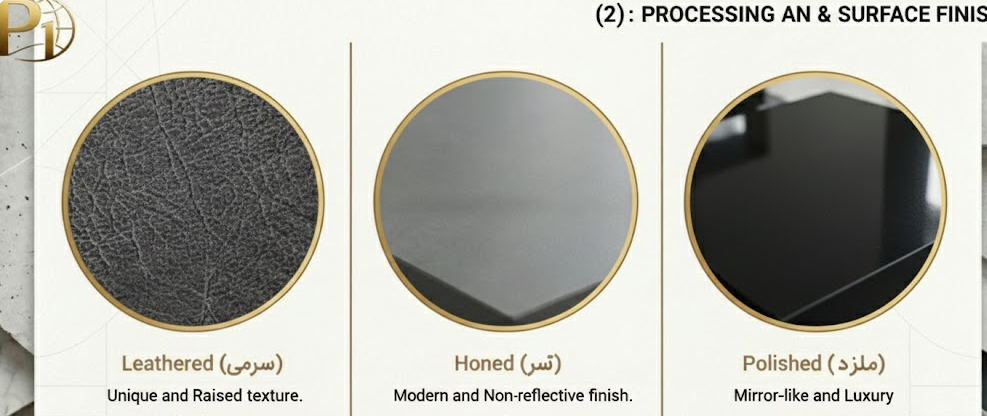
The cost of the raw stone is only part of the story. The process that turns a matte, rough block into a polished, beautiful surface is costly. The type of final surface finish directly impacts the finished price:
-
Polished: This mirror-like, brilliant finish is the most popular option for luxury interiors. Due to the requirement for multiple stages of grinding and polishing, it usually has the highest processing cost.
-
Honed (Matte): A smooth surface without the shine, creating a modern and soft appearance. Its processing cost is usually slightly lower than the polished state.
-
Leathered: This finish creates a delicate, raised texture on the stone surface, offering a different tactile feel. Its cost can rival the polished state due to the need for specialized tools.
Dimensions and Thickness: The Impact of Size on Final Cost
The general rule in the stone market is: the larger and more integrated a piece of stone is, the higher its price per square meter.
-
Slab: Large sheets of stone used for feature walls, counters, or expansive flooring are the most expensive way stone is supplied. This is due to the rarity of large, healthy blocks in the quarry and the higher costs of transport and processing.
-
Tile: Standard, smaller cuts of stone have a more economical price because they can be produced from smaller blocks.
-
Thickness: The standard thickness for construction stones is usually 2 cm. Stones with a thickness of 3 cm or more are significantly more expensive due to the higher consumption of raw materials.
How to Manage Hidden Costs in Stone Purchasing?
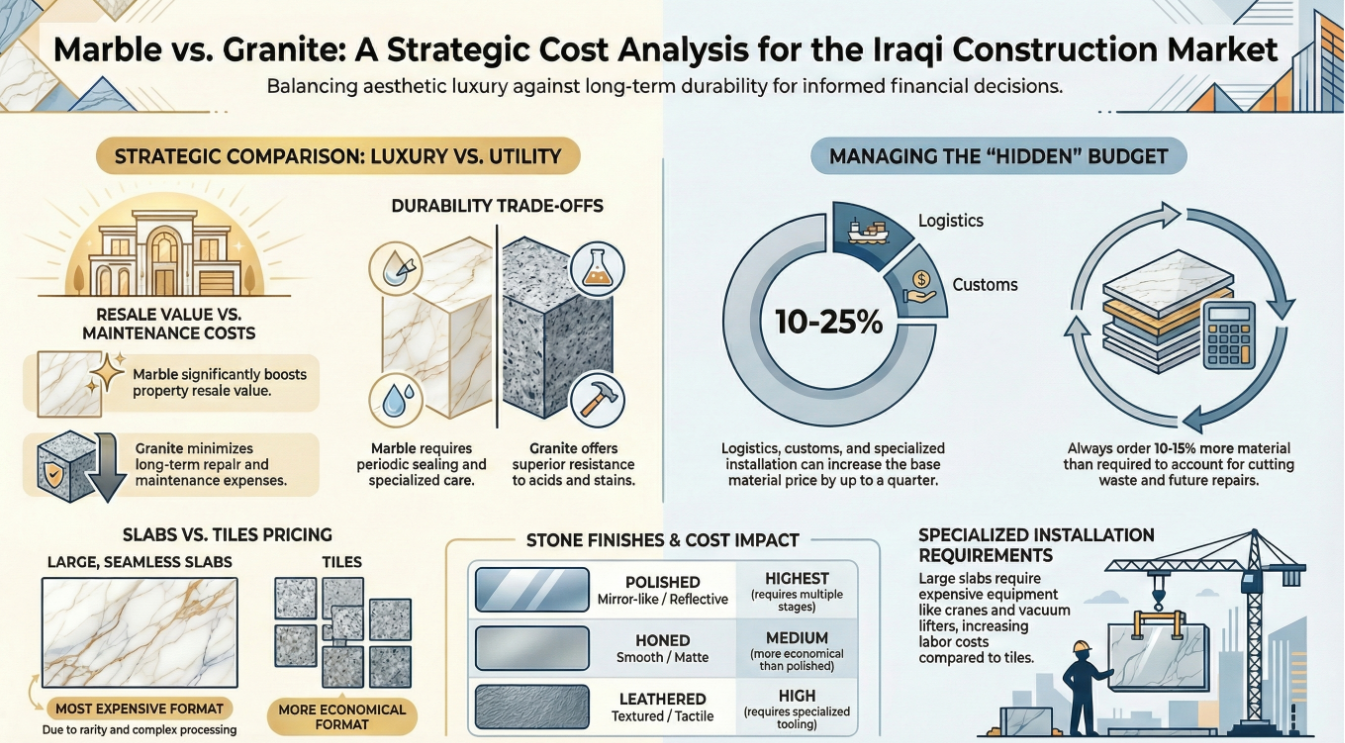
Many failed budgets in construction projects occur not because of an error in calculating the initial material price, but due to ignoring secondary costs. These “hidden costs” can easily add 10% to 25% to the cost of construction stones in Iraq. Managing these items marks the difference between a profitable project and a high-cost one.
Logistics Costs: Shipping, Customs, and Warehousing
The price you receive from a supplier, especially a foreign one, is not necessarily the final price of the stone at your project site. You must carefully examine what the price includes:
-
International Shipping: Is the cost of transport from the country of origin to the border or port in Iraq included in the price?
-
Customs Clearance and Taxes: Customs fees, tariffs, and import taxes constitute a significant portion of the final cost. These must be calculated accurately.
-
Inland Transport and Warehousing: After clearance, you must consider the cost of moving the stone from the border or port to your warehouse or project site in Baghdad, Erbil, or any other city. Also, if the project is not ready to receive the stone, warehousing costs will be added.
-
Management Solution: Request a transparent Proforma Invoice from your supplier that clearly states the price basis (EXW, FOB, CIF). The best scenario is to obtain the Landed Cost (final cost at the project site) to avoid any financial surprises.
Professional Installation and Consumables
Stone installation is a specialized art, and its quality is as important as the quality of the stone itself. Ignoring the cost of a professional installation team can make even the most expensive stones look worthless.
-
Slab vs. Tile Installation: The cost of installing large slabs is much higher than standard tiles due to the need for special equipment (such as cranes and vacuum lifters) and skilled labor to execute Book-match or Four-match patterns.
-
Quality Consumables: Saving money on glue, resin, grout, and especially Sealer for waterproofing is a major mistake. Using inferior materials can lead to stone detachment, discoloration, or permanent staining, endangering your entire investment.
-
Management Solution: Factor the installation cost into your budget as a fixed percentage of the stone price (e.g., 20% to 50%, depending on complexity) and always use the best consumables available on the market.
Cost of Waste (Loss) During Cutting and Installation
No project is completed without stone waste. A certain amount of stone is lost during transport, cutting for corners and columns, or due to potential breakage. This “waste” percentage must be included in your purchase calculations from the start.
-
Standard Waste Rate: For simple, straight tile installation, about 5% to 10% waste is natural.
-
Increased Waste in Complex Designs: For installing large pieces, diagonal designs, or complex patterns requiring many cuts, the waste rate can reach 15% to 20%.
-
Management Solution: Always order 10% to 15% more than the exact required square footage. This not only covers on-site waste but also ensures you have stone from the same sort and color available should repairs be needed in the future.
“For specialized consultation and an accurate cost analysis for your project, contact our experts.“


No comments yet.