
Comparison of Abbasabad Travertine vs. Roman Travertine (Italy)
Introduction: The Battle of Whites in Global Architecture
When discussing Classic and Roman facades, the architectural world revolves around two main poles: Roman Travertine (Romano Classico), the legacy of the Colosseum, and Abbasabad Travertine (Abbasabad Super), the white jewel of Iran.
For years, Italian stone was the unrivaled symbol of luxury. However, in 2025, the equation has changed. Many major architects in Dubai, Doha, and even Europe have shifted toward Iranian stone.
Is this shift merely due to price, or does the quality of Abbasabad truly rival its European competitor? In this precise dissection, we set aside formalities and speak the language of numbers, chemistry, and dollars.
Note: To understand the position of these stones in the global supply chain, we recommend first reviewing our [Comprehensive Guide to Natural Stone Sourcing and Export]
1. Visual and Histological Comparison (Under the Microscope)
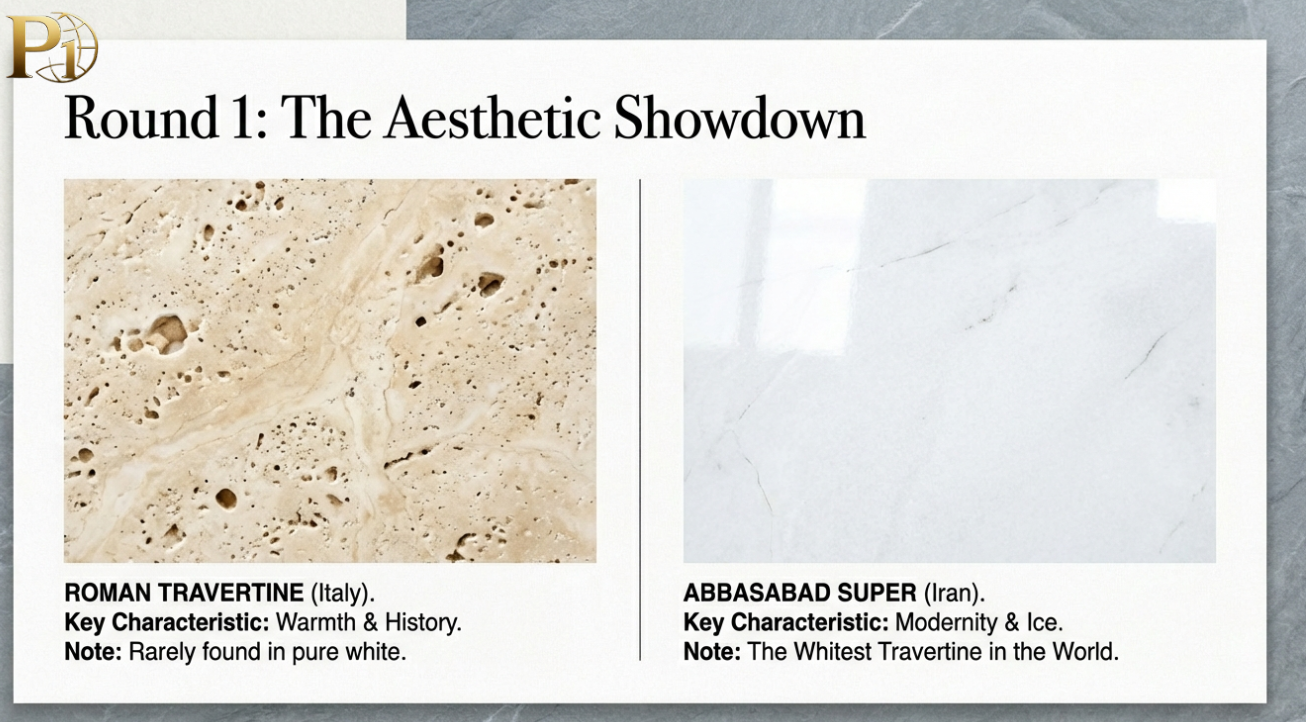
At first glance, both are “light travertines.” However, when taking macro photos of the stone texture, the differences become clear:
Roman Travertine
-
Color Palette: Often cream, beige, and bone-white. “Ice white” is rarely found.
-
Texture: The pores (porosity) are usually elongated and continuous. This gives the stone a “spongy yet hard” feel that conveys a sense of history.
Abbasabad Travertine
-
Color Palette: In Super grades, it is the whitest travertine in the world. Its whiteness is cold and modern.
-
Texture: Abbasabad has a denser texture with smaller, needle-like pores. This results in higher polishability (Glossiness), making the surface more mirror-like.
2. Chemical and Laboratory Analysis
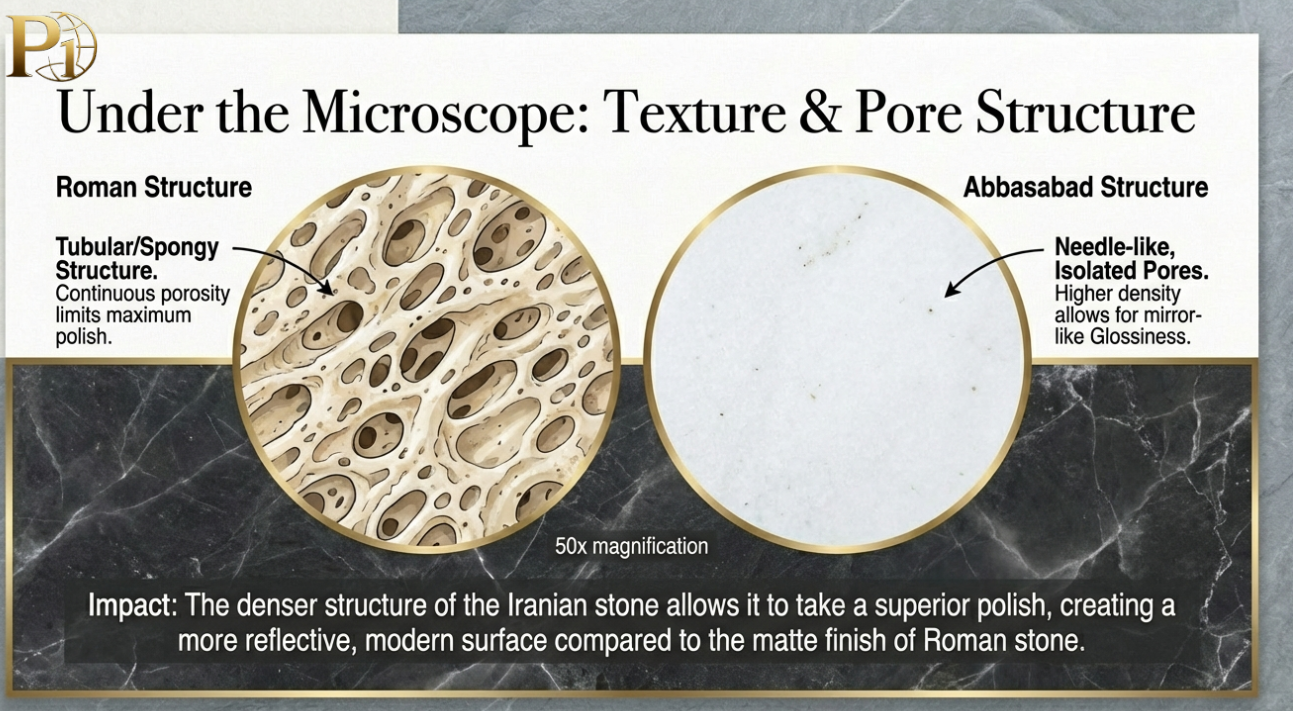
Why is Abbasabad whiter? The answer lies in the chemical table below. The presence of less Iron Oxide ($Fe_2O_3$) in Abbasabad stone results in its pure whiteness.
(Table 1 – Elemental Analysis)
Chemical Composition |
Abbasabad Travertine (Iran) |
Roman Travertine (Italy) |
Engineering Interpretation |
CaO (Calcium Oxide) |
~54.8% |
~53.5% |
Indicates lime purity and whiteness |
$Fe_2O_3$ (Iron Oxide) |
< 0.05% |
~0.35% |
Less iron = Less yellowing and more whiteness |
$SiO_2$ (Silica) |
~0.15% |
~0.40% |
Less silica = Better polishability |
Porosity |
2.5% – 4% |
3% – 6% |
Lower porosity = Lower water absorption |
3. The 50-Year Simulation Test
In the lab, we subjected both stones to Freeze-Thaw cycles and concentrated UV radiation tests to simulate 50 years of natural erosion.
Freeze-Thaw Test Results (at -20°C):
-
Roman Travertine: Due to the tubular structure of its cavities, it developed micro-cracks on the surface during high cycles (over 100 cycles).
-
Abbasabad Travertine: Due to its denser texture and isolated cavities, it showed higher resistance and maintained its cohesive structure up to 150 cycles. This stone recorded higher durability for cold climates (such as Russia or Canada).
UV Test Results (Scorching Persian Gulf Sun):
Both stones have extraordinary color stability. Unlike marbles, the colors of Abbasabad and Roman travertine are completely stable and will not change even after 50 years of radiation.
4. Mechanical Resistance and Price: Iran’s Winning Card
(Table 2 – 2025 Technical and Economic Comparison)
| Factor of Comparison | Abbasabad Travertine (Super Grade) | Roman Travertine (Classico Grade) | Final Winner |
| Water Absorption | 0.25% (Very Low) | 0.6% | Abbasabad |
| Compressive Strength | 550 kg/cm² | 500 kg/cm² | Abbasabad (Harder) |
| Specific Gravity | 2450 kg/m³ | 2400 kg/m³ | Equal |
| Global Price Range (FOB) | $40 – $70 | $90 – $160 | Iran (55% Cheaper) |
Economic Analysis:
On a 5,000-square-meter facade project, choosing Abbasabad stone instead of Italian stone can create savings of up to $300,000, while you receive a whiter and more resistant stone.
5. The Transport Challenge: Protecting the “White Gold”
Buying luxury white stone is one side of the story; delivering it safely to the project is another. Light-colored stones are highly sensitive to moisture, improper wood, and oil stains. If Abbasabad stone is placed on non-standard pallets, it may develop Yellow Stains during sea transit.
At P1, we have strict protocols for this.
Final Conclusion
Choosing between Abbasabad Travertine and Roman Travertine is a choice between “Tradition” and “Value.”
-
If the “Italian Brand” is a vital priority for your project and the budget is unlimited, Roman Travertine is the classic choice.
-
But if you are looking for stunning whiteness (Super White), higher frost resistance, and a logical price, Abbasabad Travertine is unrivaled.
Still hesitant?
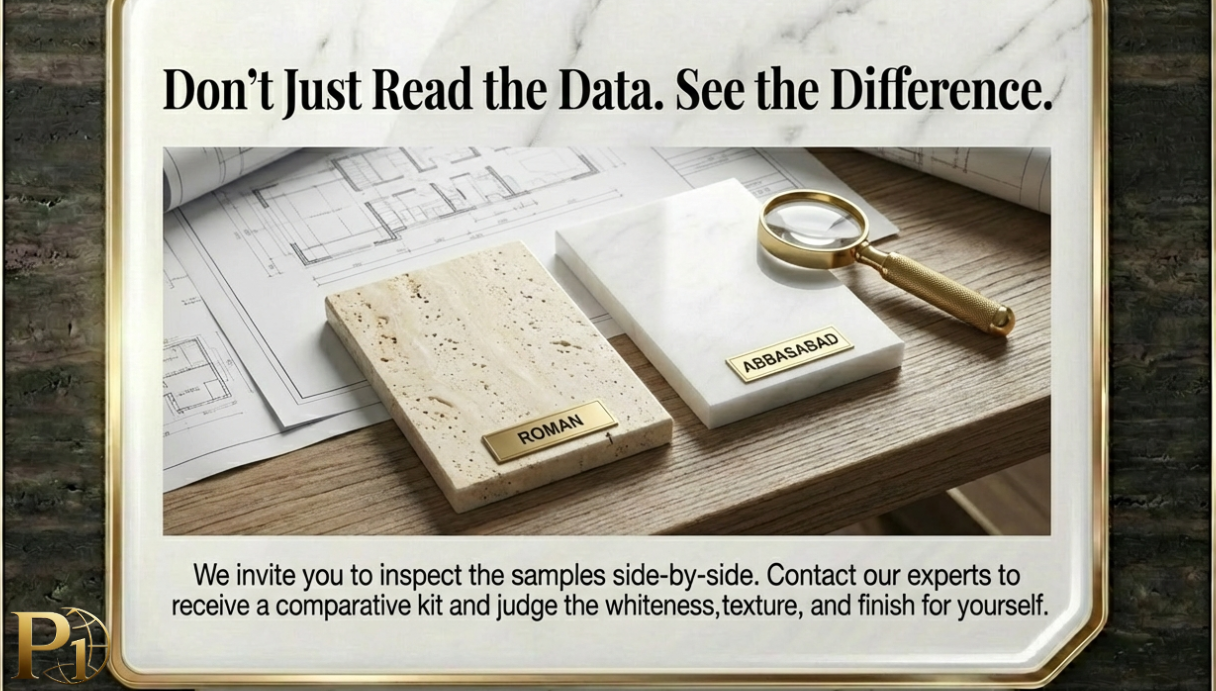
Contact our experts right now to see Samples of both stones side-by-side and judge for yourself.


No comments yet.