
Travertine Stone: Types, Applications, Finishes, and Buying Guide
Travertine is one of the most well-known natural building materials used in architecture, interior design and outdoor construction. Its warm colors, distinctive textures and diverse forms have made it a popular choice for residential buildings, commercial developments, hotels, villas and landscaping projects.
However, for architects, contractors, developers and international stone importers, choosing travertine is about more than just choosing an attractive color. The origin of the stone, the cutting direction, dimensions, thickness, surface finish, processing quality and supply stability can all influence the success of a project.
A light cream travertine chosen for a large exterior facade may have different requirements than a silver travertine slab used for an interior wall. Similarly, travertine paving for an outdoor patio requires a different evaluation than a stone specifically for a pool deck.
Understanding these differences helps buyers compare products more accurately, reduce avoidable installation problems, and organize procurement based on the actual needs of a construction project.
This comprehensive guide explains the main characteristics of travertine, its types, colors, applications, finishes and technical considerations. It also examines factors that international buyers should consider before placing a bulk or project order.
What is travertine stone?
Travertine is a natural sedimentary limestone formed by the precipitation of calcium carbonate from mineral-rich water, usually in environments associated with springs and geothermal activity.
During its formation, gases, organic matter, and changes in water movement may contribute to the creation of pores and cavities. These natural characteristics give travertine its unique texture and distinguish it from many other building stones.
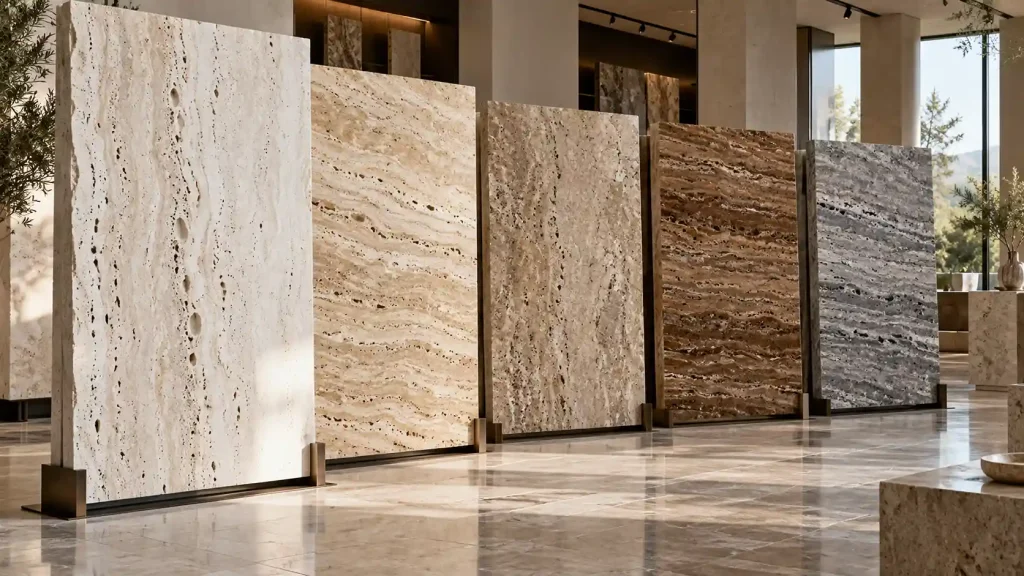
Travertine belongs to the broader limestone family, but has its own recognizable visual identity. The stone is often known for its cream, ivory, beige, walnut, brown, and silver-gray colors, although its exact appearance depends on geological and quarry conditions.
This stone can be made into blocks, slabs, tiles, architectural elements, paving units, and custom pieces.
Its versatility makes it suitable for a wide range of design concepts, from traditional classic facades to contemporary interiors.
Why is travertine popular in architecture?
Travertine offers several properties that are of interest to designers and construction professionals.
One is its natural appearance. Variation in color, veining, and texture can create surfaces with greater visual depth than uniformly produced materials.
Another advantage is the wide range of finishes available. Depending on the intended application, travertine can be polished, honed, brushed, roller-polished, or processed with other suitable surface treatments.
The stone is also available in a variety of cut patterns, allowing designers to choose between directional veining and a relatively uniform, cloud-like appearance.
Travertine can work well in warm architectural color schemes and can be combined with wood, metal, glass, concrete, and other natural materials.
However, suitability should always be assessed in relation to the specific product and application. Natural variations, porosity, exposure to moisture, required slip resistance and local installation conditions should all be taken into account.
Main types of travertine stone
Travertine can be classified in several ways: by geological origin, quarry, color, cutting direction, or shape of the final product.
From a commercial perspective, buyers typically identify travertine based on its color and appearance, the type of product offered, and its intended architectural use.
White and light cream travertine
White and light cream travertine is often considered for projects where a bright, subtle, and relatively uniform appearance is required.
These colors are especially suitable for classic facades, luxury homes, villas, and buildings that feature brightly colored architectural details.
Some projects require very pale, uniform stone over a large area. In such cases, buyers should not judge an order based on an attractive sample.
The more important question is, can an acceptable range of colors and appearances be provided across the entire project volume required?
For large displays, coordination between production batches can be as important as the brilliance of a single piece.
Beige and walnut travertine
Beige and walnut travertine create warmer, earthier architectural surfaces.
They can be suitable for exterior cladding, interior flooring, wall cladding, hospitality projects, and traditional or contemporary spaces.
Their natural patterns may be more visible than in selected light cream varieties.
For projects where a bit of variety is desired, these stones can create an attractive balance between nature and design stability.
However, the term “beige travertine” can cover a wide range of appearances. Samples from different quarries, grades, and production batches should not be automatically considered interchangeable.
Silver and gray travertine
Silver travertine is known for its gray, silver, and sometimes brown or beige mineral streaks.
Its layered appearance makes it particularly attractive for contemporary architecture, feature walls, reception spaces and interior surfaces with a distinctive visual impact.
The direction of the veins can have a huge impact on the appearance of silver travertine after installation.
For large panels, designers may also consider the continuity of patterns between adjacent pieces.
🔗 Silver travertine slabs for modern projects
Travertine by mine or origin
Two stones sold under the general name of travertine may differ significantly in appearance and processing characteristics.
The origin of the mine can affect the background color, vein structure, porosity, and range of commercial grades available.
Iran is an important source of natural travertine, with varieties associated with different mining areas and recognizable trade names.
However, the quarry name alone does not guarantee that every slab or tile will have the same appearance.
Buyers should check the actual grade, available inventory, processing details, and representative samples before placing an order.
🔗 Iranian Travertine: Colors, Cuts, and Export Supply
Travertine Colors and Their Architectural Applications
Choosing a color is one of the first decisions in determining the specifications of natural stone.
For travertine, the selection often begins with the desired architectural effect, not a specific quarry.
Light colors can emphasize brightness and visual order. Warm beige tones can create a softer atmosphere, while silver and darker colors can create stronger contrast.
In classical architecture, light cream and ivory colors are often considered for facades with columns, cornices, window frames, and decorative stonework.
In contemporary architecture, travertine may be combined with dark aluminum frames, large glass panels, wood, and exposed concrete.
Before selecting the final product, the interaction between the natural stone and its surrounding materials must be studied.
Why is color stability important in large projects?
A small sample may appear almost perfectly uniform, but natural stone is inherently variable.
When several hundred or several thousand square meters are installed, the differences between individual pieces become more apparent.
For this reason, buyers must define an acceptable color and vein range before production or delivery.
A slightly warmer shade, present in sufficient quantity, can create a more harmonious look than several separate batches of unusual pale stone with completely different tones.
Representative samples, slab photos, and category-specific endorsements can help create realistic expectations.
Veined Travertine vs. Cross-Striped Travertine
The cutting direction is one of the most important factors affecting the visual appearance of travertine.
Natural layers of stone can create different patterns depending on how the block is cut.
What is veined travertine?
Veined travertine is processed so that the sedimentary layers of the stone appear as directional lines or stripes across the surface.
This treatment can create a linear and structured appearance.
This method is particularly suitable for projects where designers want to emphasize horizontal or vertical movement in walls, facade elements, or interior panels.
The final visual result depends on the stone itself and how the pieces are arranged during installation.
What is cross cut travertine?
Crosscut travertine is cut in a direction that creates a less linear, more cloud-like or mottled appearance.
The resulting surface, depending on the type of stone, may appear smoother and more uniform.
Cross-cut materials are often considered for flooring, wall coverings, and projects where perfectly directional grain is not part of the desired design.
No one cutting direction is better overall.
The correct choice depends on the architectural style, available materials, product dimensions, and desired final appearance.
🔗 Veined Travertine vs. Cross-Stone Travertine: Key Differences
Travertine products: blocks, slabs and tiles
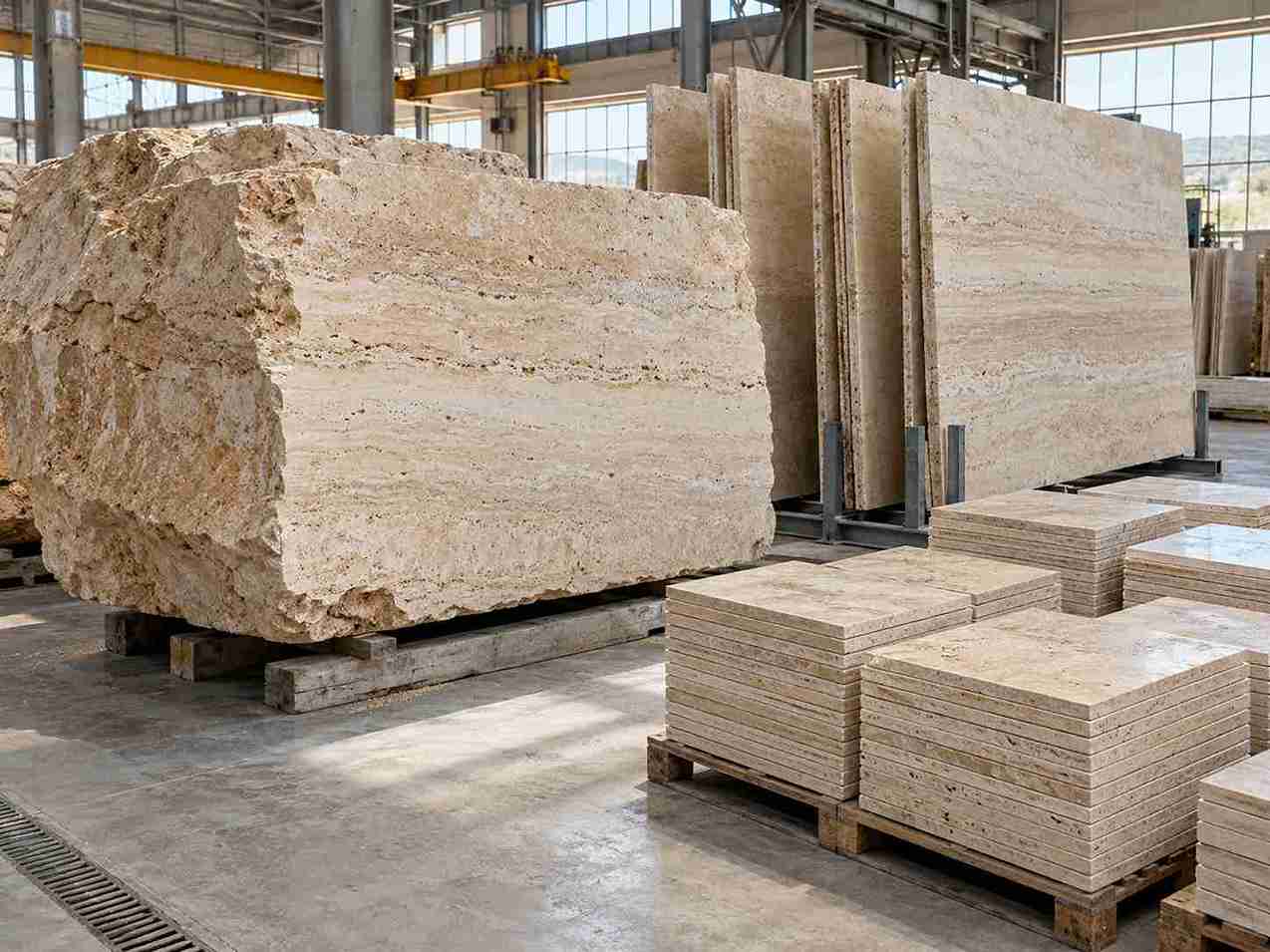
Travertine comes in several commercial formats, each covering a different stage of the stone supply chain.
Understanding these formats is especially important for importers, manufacturers, distributors, and international project contractors.
Travertine blocks
Travertine blocks are large pieces of natural stone that are extracted from quarries and then processed into finished slabs or tiles.
Blocks are mainly purchased by factories, stone processors, and buyers who have their own cutting and polishing facilities.
Block preparation requires consideration of dimensions, geological structure, visible defects, expected cutting efficiency, and handling requirements.
The yield of a block depends on factors such as its shape, health, desired final dimensions, and cutting process.
When purchasing blocks, buyers should specify how dimensions, weight, quality, and acceptance criteria will be documented.
🔗 Travertine blocks for importers and manufacturers
Travertine slabs
Travertine slabs are large-sized stone panels produced by cutting natural stone blocks into small pieces.
They are widely used for interior wall cladding, feature walls, large floor spaces, stair components, countertops in suitable applications, and custom architectural elements.
Slabs allow designers and builders to evaluate the natural movement of stone on a larger scale.
They can also provide flexibility for custom cutting, although the usable dimensions available depend on the original slab and any natural or processing imperfections.
For international purchases, slab thickness, surface finish, dimensions, grade stability, reinforcement if required, and packaging method must be confirmed prior to shipment.
🔗 Travertine slabs: sizes, finishes and project supply
Travertine tiles
Travertine tiles are finished pieces that are cut to specific dimensions for installation.
They may be chosen for interior floors, walls, commercial spaces, bathrooms, residential complexes, and other suitable applications.
Ordering tiles often requires more precise dimensional coordination than ordering slabs.
Thickness tolerances, edge finish, calibration, surface treatment, and color stability can significantly affect the quality of the installation.
For large projects, a specific tile schedule can help buyers organize production quantities and minimize ordering errors.
🔗 Internal link — Travertine Tile: Sizes, Finishes and Applications
Common Travertine Surface Finishes
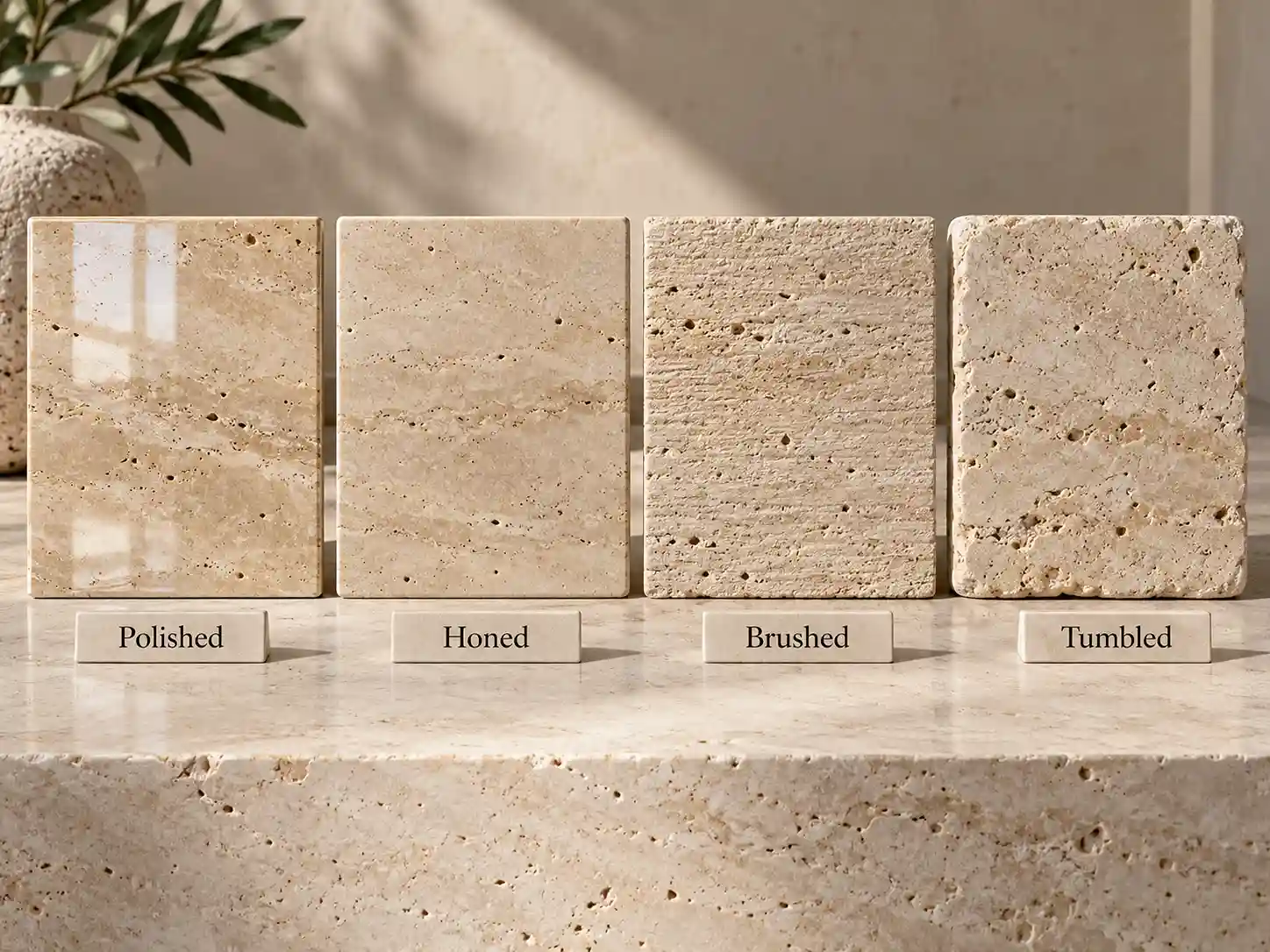
Surface finishing changes both the appearance and functional properties of travertine.
The appropriate coating should be selected based on location, expected traffic volume, maintenance requirements, moisture content, and architectural objectives.
Polished travertine
Polished travertine has a reflective surface that enhances certain natural colors and patterns.
It may be chosen for decorative interiors where a more formal look is desired.
However, polished surfaces can become slippery when wet. Without proper evaluation, they should not be considered for moisture-prone walking areas.
Polished Travertine
Polished travertine has a smooth, matte or low-gloss surface.
This material is widely used where a softer, less reflective appearance is preferred.
Polished surfaces can complement both classic and contemporary designs.
Performance will still depend on the product and surface characteristics, and slip resistance to moisture should be assessed where necessary.
Brushed and honed travertine
Brushed finishes and roller finishes create different textured looks.
Honed stone can highlight the natural character of the surface, while roller processing often creates softer edges and an aged visual effect.
These finishes are commonly considered in rustic interiors, landscape designs, terraces, and other applications where texture plays a role in the design.
A textured appearance does not automatically determine suitability for any outdoor or wet application. Project-specific performance requirements are still important.
Filled and unfilled travertine
Travertine naturally contains pores and cavities that may be filled during processing.
Filled travertine can create a smoother surface, but buyers should evaluate the filler material, the quality of the application, and its suitability for the intended environment.
Unfilled travertine retains more visible natural voids and may be selected for specific aesthetic effects.
Selection should consider maintenance, light exposure conditions, cleaning requirements, and installation details.
Where is travertine stone used?
Travertine is used in exterior architecture, interior design, landscaping, and custom stone construction.
Its suitability depends on the choice of material, finish, dimensions, thickness, and appropriate installation system.
Exterior view of the building
Exterior facades are among the most well-known applications of travertine in many construction markets.
Light cream travertine is often associated with classical and Roman-inspired facades, while beige and silver varieties may be used in both traditional and contemporary designs.
Large-scale projects require careful attention to the entire cladding system.
Stone dimensions, installation methods, structural design, wind loads, movement joints, weather exposure, and local building codes must be considered.
The choice of stone should be coordinated with qualified architects and facade engineers, not based solely on appearance.
Interior flooring
Travertine can create warm and visually cohesive interior flooring.
It is often considered for residential spaces, hotel interiors, hallways, and other spaces where natural stone is part of the design concept.
Proper surface finish, tile size, expected wear rate, cleaning process, and slip resistance requirements should be considered.
Areas with heavy traffic or frequent exposure to moisture may require further technical evaluation.
🔗 Internal link — Travertine flooring: design, finish and selection
Interior walls and raised surfaces
Travertine slabs and tiles can be used for feature walls, reception areas, decorative panels, and other vertical surfaces.
In contemporary projects, large-sized travertine can be chosen to create a continuous mineral texture with relatively few seams.
The choice between cross-cut and veined cut is especially important when the design relies on the direction of the natural pattern.
Outdoor paving and landscaping
Travertine pavers can be considered for patios, garden paths, courtyards, terraces, and landscaping projects.
For these applications, buyers should evaluate surface texture, thickness, dimensional accuracy, weather exposure, and expected loads.
Where freeze-thaw conditions occur, the suitability of materials should be confirmed by appropriate testing and project specifications.
Installation methods, drainage, bed conditions, and maintenance can all affect long-term performance.
🔗 Internal link — Travertine Pavers: Sizes, Finishes and Wholesale Supply
Pool cover and area around the pool
Travertine is also used in some swimming pool environments, including poolside units and surrounding paved areas.
Pool liner components may require specialized edges, specific dimensions, proper surface finish, and careful consideration of water exposure.
Buyers should evaluate slip resistance, cleaning and chemical exposure, water absorption, dimensional stability, and local installation system requirements.
A product that is suitable for interior decorative coating should not automatically be assumed to be suitable for use around the pool.
🔗 Internal link — Travertine pool cover: dimensions and project supply
Different sizes and thicknesses of travertine stone
Travertine is available in a variety of sizes, but actual production capabilities vary depending on the supplier, block dimensions, stone type, and processing facilities.
Tiles may be produced in standard or custom dimensions, while slabs are usually supplied in larger, individual pieces.
Custom molds may be required for facade details, staircases, large interior panels, architectural columns, and landscaping components.
Thickness should be determined based on the application and the relevant engineering or installation requirements.
Choosing a thinner product simply to reduce the purchase price is not recommended.
For commercial orders, buyers must request confirmation of nominal dimensions and allowable tolerances.
Why is thickness tolerance important?
Even small variations in stone thickness may affect installation.
Uneven thickness can complicate alignment, increase setting time, and create differences in the final surface.
Therefore, a product with a more uniform process can contribute to easier installation and reduced waste at the manufacturing site.
This is one reason why procurement teams should compare processing specifications, not just the nominal thickness printed on a proposal.
Technical features that buyers should evaluate
The specifications of natural stone should be based on the intended application and the results of relevant tests.
Although travertine is often discussed for its color and appearance, several technical characteristics can affect its suitability.
Water absorption and porosity
Travertine contains natural pores, but porosity and water absorption vary between different materials.
These properties are related to moisture exposure, cleaning, surface treatment, and installation design.
A visually appealing slab should not be considered technically suitable for any environment without additional evaluation.
Strength and durability
Mechanical performance depends on the geological characteristics of the rock, defects, test results, dimensions, and installation conditions.
For engineering applications, buyers may need information on compressive strength, flexural strength, abrasion resistance, or other related properties.
The required tests depend on the project and the relevant standards.
Surface performance and maintenance
The choice of finish can affect slip resistance, stain behavior, and maintenance.
Travertine is based on calcium carbonate and may be affected by acidic substances.
Therefore, proper stone care products, cleaning methods, and maintenance procedures are important.
If necessary, sealing can be considered, but this does not make the stone completely stain-proof or eliminate the need for maintenance.
For projects that have formal performance requirements, buyers should request the relevant technical documentation from the supplier.
What factors determine the price of travertine stone?
The price of travertine stone varies depending on the product, quality grade, supply conditions, and project needs.
There is no reliable price for any travertine slab, tile, or block.
Origin of the mine and grade of the stone
The origin of the quarry may affect the commercial value of travertine because different deposits create different colors, patterns, and material properties.
However, within the same mine, blocks and final products may vary significantly.
Grade consistency, background color, natural veins, and availability of a particular selection can all affect the suggested price.
In some markets, selected light color grades command higher prices, but this should not be considered a universal rule for any type of travertine.
Dimensions and processing
Larger final parts may require careful block selection and cutting, which sometimes results in lower production yields.
Custom dimensions can introduce additional processing requirements.
Thickness, surface finish, filling, edge finishing, calibration and other manufacturing steps may also affect the cost.
If poor dimensional accuracy or damaged edges increase installation waste, a cheaper product is not necessarily a better option.
Order quantity and supply stability
Order volume is another important business consideration.
A small order of standard tiles and a large project requiring several thousand square meters of carefully matched stone create different production and supply requirements.
Larger quantities do not always guarantee a lower price per square meter, especially when the requested grade is difficult to consistently supply.
Packaging, shipping and delivery conditions
The purchase price of the stone is only part of the shipping cost.
Packaging materials, handling, shipping, insurance, applicable customs duties, and delivery terms may affect the final amount paid by the buyer.
Importers should confirm the relevant Incoterms rules and determine which costs are included in the supplier’s quoted price.
Comparing two proposals without examining their delivery terms can lead to incorrect conclusions about the actual cost of the project.
How to choose a reliable travertine supplier
For international buyers, choosing a supplier is not simply about finding the lowest bid.
A reliable business process should help the buyer understand what materials are being provided, how they are being processed, and how the order will be delivered.
Request to delete product details
An effective pre-factor should specify the type of stone, grade or selection approved, dimensions, thickness, finish, quantity, and packaging requirements.
Where applicable, processing tolerances and the method of sample verification should also be documented.
Clear specifications reduce the risk of receiving a product that matches the brand but does not match the expected look of the project.
Confirm actual production samples and materials
Photos are useful for initial selection, but lighting conditions and screen calibration can alter the perceived color of the stone.
For major projects, buyers can request demos and images or videos of the existing production piece.
Verification should focus on an acceptable range of natural variations, rather than expecting every piece of stone to look the same.
Delivery confirmation and documentation
Production schedules, shipping arrangements, packing lists, commercial invoices, and destination-specific import requirements must be agreed upon prior to shipment.
The exact documents required depend on the countries involved, the terms of the contract and the type of transport.
For large orders, a defined inspection and acceptance process can help reduce misunderstandings.
🔗 Internal link — Travertine supplier for international projects
Wholesale Travertine for Importers and Distributors
Bulk travertine purchases typically involve recurring supply, bulk quantities, or project-based material specifications.
Importers and distributors may require multiple formats or grades, depending on their customers.
A distributor that serves residential contractors may prioritize fixed tile dimensions and popular commercial colors.
A builder may prefer blocks or sheets that can be processed for custom architectural elements.
A project contractor may require a specific approved finish, thickness, and grade to be delivered according to the construction schedule.
These differences explain why wholesale procurement must begin with a clear understanding of the customer’s business model.
Standard supply versus project specific orders
Standard products may have more flexibility in purchasing and resupply.
Project-specific orders usually require more detailed coordination because dimensions, grade stability, packaging, and delivery dates are tied to construction activities.
In both cases, buyers need to clarify whether the desired product is available from existing inventory or requires new production.
🔗 Internal link — Travertine wholesale for importers and distributors
How to plan travertine stone supply for large projects
Large construction projects require more coordination than individual stone purchases.
The first step is to define the technical and architectural requirements before requesting a quote.
Buyers should specify the application, estimated quantity, preferred color, grade range, dimensions, thickness, finish, delivery destination, and expected project timeline.
In cases where a project involves multiple stone applications, it can be helpful to create separate plans for cladding, flooring, paving, and architectural details.
Why is material stability important?
Natural stone varies from one block and production batch to another.
For large projects, consistency doesn’t necessarily mean complete visual uniformity.
Instead, it means that the parts supplied remain within the customer’s approved appearance range.
This can be supported through representative samples, batch photos, defined selection criteria and appropriate inspection procedures.
Planning for waste and alternative materials
Project procurement should consider expected installation waste, cutting losses, potential breakages, and replacement needs.
The appropriate allowable amount depends on the product format, layout pattern, design complexity, site conditions, and project specifications.
Ordering a realistic quantity initially can help reduce the risk of ordering a completely different batch in the future.
Packaging and international transportation
If packaging methods do not match the size, weight, and fragility of the stone, it may be damaged during loading, transportation, and unloading.
Slabs, tiles, and blocks require different considerations when moving.
Buyers should discuss protective packaging, load stability, lifting methods, and the suitability of the chosen shipping method.
For international shipments, documentation and compliance with destination market requirements must also be verified.
Iranian Travertine for International Construction Markets
Iranian travertine is offered in the international natural stone trade with a wide range of colors, patterns, and commercial grades.
The country has several known areas for travertine mining, and Iranian materials can be supplied in various processed forms, depending on availability and production capabilities.
For international buyers, Iranian authenticity may be relevant when sourcing light-colored stone, warm beige tiles, silver slabs, and natural stone blocks.
However, the suitability of any particular material depends on the actual characteristics of the product, not just its origin.
Important notes for importers
Importers must evaluate supplier documentation, sample approval, product compatibility, packaging quality, and contract terms.
Market-specific requirements, including customs procedures, product standards, payment terms, and import restrictions, should also be considered.
A technically acceptable stone may still be unsuitable for trading if delivery conditions or import requirements have not been properly addressed.
For this reason, product selection and business planning must go hand in hand.
Common Mistakes When Buying Travertine Stone
Several avoidable mistakes can complicate stone procurement.
One is choosing materials exclusively from a promotional photo. The images may not accurately represent the entire production batch or the natural range of color variation.
Another is comparing prices without checking thickness, dimensions, grade, finish, and delivery terms.
The third mistake is choosing a stone before confirming the intended application. A cladding that is suitable for an interior wall may not be suitable for a wet floor or an exterior space exposed to moisture.
Buyers may also underestimate the importance of packaging, installation waste, or future replacement materials.
Finally, ordering rare or premium stones without confirming sufficient inventory can cause problems when the project requires additional stone.
A structured procurement process helps mitigate these risks.
Frequently Asked Questions About Travertine Stone
Is travertine stone suitable for exterior use?
Travertine can be suitable for exterior facades when the selected product, cladding system, installation method, and its technical performance meet the project requirements.
Stone should be evaluated in relation to climate, building design, local regulations, and relevant engineering specifications.
What is the difference between travertine slabs and tiles?
Slabs are larger stone panels that provide the flexibility needed for custom construction and large applications.
Tiles are finished pieces that are produced in specific dimensions and are often used for flooring and wall installations.
The most suitable format depends on the design, project scale, installation requirements, and processing schedule.
Which color of travertine is best for a luxury building?
There is no universal color as the best color.
Light cream and ivory colors are often chosen for light, classic facades, while beige, walnut, and silver travertine can support other luxurious design concepts.
This choice should reflect architectural style, material compatibility, budget, and availability.
Is filled travertine better than unfilled travertine?
Neither is automatically better for every application.
Filled travertine creates a more continuous surface, while unfilled stone retains visible natural voids.
The correct specification depends on appearance, exposure to light, maintenance, and intended use.
Does higher quality travertine always mean a higher price?
Higher grade or carefully processed materials may cost more, but pricing depends on many factors.
The origin of the mine, commercial demand, dimensions, final payment, production requirements, order quantity and shipping terms all affect the final price.
Can travertine be ordered for large international projects?
Travertine can be supplied for large international projects, subject to available materials, processing capacity, agreed specifications and commercial arrangements.
Buyers should ensure grade stability, production planning, quality inspection, packaging, and delivery terms before placing an order.
Explore natural stone products at P1
P1 operates in the field of international trade and commercial supply workflows involving natural stone products.
For buyers evaluating travertine, the most effective starting point is a clear description of the product’s application and requirements.
Whether the project requires architectural slabs, polished tiles or stone for further construction, the procurement discussion should cover the desired color, approximate quantity, dimensions, thickness, finish and delivery destination.
Reviewing available product information can help buyers compare natural stone options before making a detailed request.
🔗 Check out the P1 natural stone catalog
For project-based requests, providing a full specification from the outset can help clarify product options and create a more accurate business discussion.
Conclusion: Choosing the right travertine stone
Travertine stone offers a wide range of possibilities for architecture, interior design, and landscaping.
Natural colors, distinctive layering, and availability in various formats make it a valuable option for designers, importers, distributors, and contractors.
However, a successful travertine purchase depends on more than just its appearance.
Buyers should evaluate the available mine and grade, cutting direction, dimensions, thickness, surface finish, technical properties, processing quality, and supply.
For international orders, packaging, shipping conditions, documentation, and project plans must also be considered.
The best choice is not necessarily the palest, most expensive, or most visually striking travertine.
This is a material that meets the project’s architectural goals, technical requirements, budget, and supply conditions.
With clear specifications and a structured purchasing process, buyers can make more informed decisions and achieve greater consistency in their construction projects.


No comments yet.